
Story · 5 min read
Naga Shawls: What the Weaves and Colours Mean
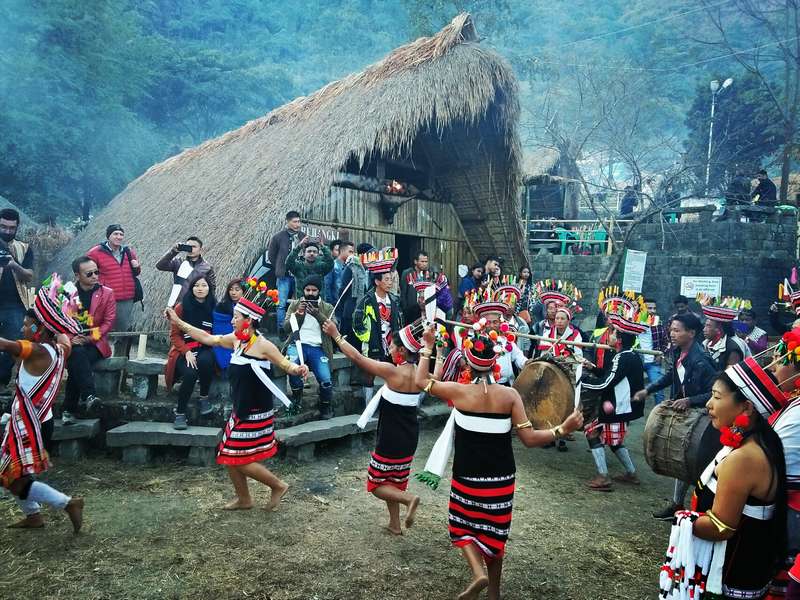
A Naga shawl is a worn document: tribe, rank, achievement and village readable in the weave. You cannot buy a real one correctly without knowing what it says. Here is the honest primer, tribe by tribe, from the same records our tribe pages are built on.
What the weaves say
- Angami: Angami men wear the white lohe shawl with black-and-red bands.
- Ao: Ao shawls are a language of rank: the tsüngkotepsü warrior shawl with its medallion bands, and women\u2019s striking red-and-black skirts.
- Chakhesang: Chakhesang shawls carry intricate geometric borders in red, black and white.
- Chang: Chang women wear heavy coin-and-bead necklaces over red-and-black cloth.
- Kachari: Kachari women weave bold geometric dokhona.
- Khiamniungan: Khiamniungan heirloom necklaces of coral, carnelian and glass beads are among the most valuable in the state.
- Konyak: Face-tattooed elders in red-and-black with shell-and-brass chestpieces.
- Kuki: Kuki women\u2019s saipikhup striped skirts and bronze kongvil drums.
- Lotha: Lotha shawls in striking black-red-white geometry.
- Phom: Phom women wear blue-black cloth with wide woven borders.
- Pochury: Pochury cloth carries fine red-and-white weave.
- Rengma: Rengma shawls use dense black with narrow red-and-white bands.
- Sangtam: Sangtam women\u2019s red skirts carry strong symbolic bands.
- S\u00fcmi: S\u00fcmi warrior shawls (apelu) with red medallion fields.
- Tikhir: Tikhir cloth favours deep indigo with red edging.
- Yimkhiung: Yimkhiung shawls mix earth-reds with cream.
- Zeliang: Zeliang women\u2019s white-and-red heron-motif skirts are the signature.
The rules of wearing
Many shawls are earned, not chosen: warrior grades, festival roles, elder status. A tourist draping a tsungkotepsu wrong is a small offense; wearing it right earns grins. When in doubt, ask the weaver; at Kisama the morung elders will tell you exactly what you are looking at.
How to buy honestly
Buy from weavers’ cooperatives and village stalls, not airport shelves: the price difference is smaller than the story difference. At the Hornbill Festival the arena-edge stalls are cooperative-run. Expect handloom prices for handloom work, and check the back of the weave: machine copies have flat reverses.
Quick answers
What is the Angami shawl called? The lohe, white with black-and-red bands.
Which shawl means warrior status? Among the Ao, the tsungkotepsu with its medallion bands; other tribes have their own earned grades.
Where do I buy real Naga shawls? Cooperative stalls at Kisama and festival grounds, and weaver collectives in Khonoma and Kohima.
Wear the story, not just the weave: message us for festival-week trips.
Planning a trip like this?
We build itineraries around your dates, group and budget, a real person replies with an honest price.